Department of Energy Renews 60-Year MSU Partnership
A $13.6 million grant ushers in three years of solar-powered science
What if you could unlock the full power of the sun?
That’s part of the question that a $13.6 million grant from the Department of Energy is poised to help researchers from Michigan State University solve. The grant, awarded by the U.S. Department of Energy’s Basic Energy Sciences (BES) program, provides continuing support for the MSU-DOE Plant Research Laboratory until 2029.
“This award underscores the power of collective strength at the PRL: our shared commitment to working across disciplines and supporting one another,” said Federica Brandizzi, a University Distinguished Professor who first joined the PRL in 2006 and now serves as its director.
“Our success is not defined by individual efforts, but by how we bring them together,” Brandizzi added. “We are also fortunate to be embedded in a vibrant Plant Science community and the broader MSU environment, which support our mission by fostering collaboration, creativity, and growth.”

Scientists in the PRL are working together to imagine the future—and the untapped potential—of a 3.9-billion-year-old metabolic process.
The PRL’s nine labs, which comprise over 100 personnel, are focused on photosynthesis: the molecular process that powers organisms like plants, algae and cyanobacteria, and which produces the vast amount of oxygen and biological energy necessary to support life on Earth.
A Day in the Sun
As one of the world’s premier centers for photosynthesis research, the PRL has spearheaded efforts to unlock the molecular complexities of photosynthesis and how plants adapt to changes in their environment.
Even under the best circumstances, plants must employ complex strategies to manage the capture, conversion and storage of energy as conditions—like light, temperature and water availability—fluctuate. Understanding how plants organize and regulate the component processes and structures that facilitate photosynthesis can help researchers elicit improvements at the level of a gene, organelle or cell. Such changes can make plants more resilient to stress or to boost yields of valuable crops.
These discoveries stem from the PRL’s unique and collaborative structure. Its interdisciplinary research program spans experimental biology, computational modeling, and field-based measurements, and facilitates interconnected research from the molecular level to whole organisms and natural environments.
The renewed research program is divided into three sub-projects. Each subproject synthesizes research to address questions that overlap but unfold across different times and scales:
- Assembly: How are the complex moving parts necessary for photosynthesis organized? PRL researchers are using genetics, imaging, and bioengineering to understand how the essential components of the photosynthetic process are created, transported and assembled into functional structures within cells.
- Coordination: How do critical ingredients flow through the photosynthetic network? Organisms sense, absorb, direct and convert essential elements like water and light to keep photosynthesis running—researchers are working to understand how these pathways are organized and maintained. This project also examines the role of conserved and uncharacterized proteins—genetic components which are thought to play important biological roles, but whose functions have yet to be established.
- Adaptation: Photosynthesis is the source of most atmospheric oxygen and emerged in a time when oxygen was scarce. So how do photosynthetic organisms adapt to dynamic, oxygen-rich environments? Researchers are identifying mechanisms that help plants manage stress, minimize damage, and regulate rubisco—the key molecule that converts carbon dioxide into usable sugars.
Understanding how organisms capture and convert sunlight into useable energy, even under unfavorable conditions, provides a foundation for innovations across an array of fields, including renewable bioenergy production, sustainable agriculture, and advancements in biotechnology and medicine.
“Federal Government university partnerships are essential to tackling complex challenges, and the MSU-DOE Plant Research Laboratory is a standout example,” says Shashank Priya, vice president for research and innovation. “The DOE’s renewed investment supports the kind of long-horizon, fundamental research that drives future breakthroughs, from improving plant productivity to enabling new biotechnologies. We’re honored to continue this collaboration and congratulate the PRL team on this significant milestone.”
Focused on Growth
Now in its sixty-first year, the PRL has evolved since its inception in 1965 into one of MSU’s flagship plant research programs and an incubator for collaborative next-generation scientists. The PRL hosts an exceptional training program for early career researchers: since 2023, the PRL has supported over 160 scientists, ranging from undergraduates to postdoctoral scholars, expanding opportunities for cross-disciplinary training and collaboration.
This environment continues to yield impactful science: over the past three years, PRL members submitted 14 patents and invention disclosures; each one a critical step toward applying leaps in fundamental research to applied tools and technologies and connecting lab-based science to real-world problems.
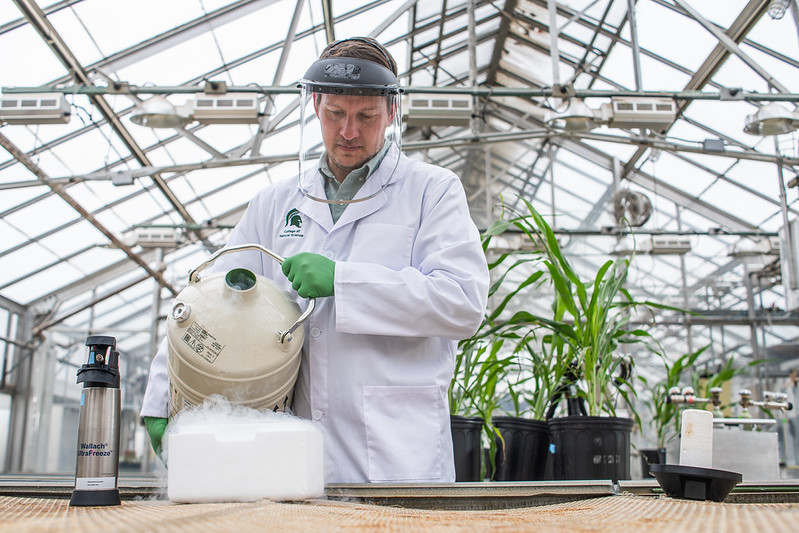
PRL researchers authored 148 peer-reviewed publications between 2023 and 2026, 50 of which were directly supported by DOE funding, and 24 more supported by the infrastructure developed and bolstered by the agency's continued support.
The group has also long been a hub for internationally recognized scientists and leaders in plant science: among the current PRL’s faculty are two National Academy members (out of 14 total in the history of the PRL), multiple fellows of preeminent societies including the American Association for the Advancement of Science (AAAS) and the American Society of Plant Biologists (ASPB), as well as University Distinguished professors, John A. Hannah professors and MSU Research Foundation professors.
The PRL celebrated its 60th anniversary—and its longstanding contributions to plant science—in 2025.