At MSU, Core Facilities Power Research & Training
Researchers at MSU don't have to travel far to access the fined-tuned scientific tools needed to power their next big breakthrough — usually, it's just a walk down the block.
Meet Bailey Kleven, a graduate student in the Howe Lab who studies how plants juggle growth and defense. Not content just to have their samples analyzed, she and fellow Spartan scientists are getting invaluable hands-on training at facilities like the Mass Spectrometry and Metabolomics Core.

“At the MSU Mass Spectrometry and Metabolomics Core, we help researchers fine-tune
experiments, navigate analytical challenges, and move discoveries across the finish
line,” explains Maraym Goudarzi, an associate professor in the department of Biochemistry & Molecular Biology and
director of MSU’s Mass Spec facility.
Liquid Chromatography-Mass Spectrometry, or LC-MS, is a technique used by researchers
to analyze the component compounds that make up a sample like plant tissues. LC-MS
is often used by plant scientists to understand the makeup of specialized compounds
called metabolites.
In the Howe lab, researchers like Kleven study how plants juggle growth and defense; both critical functions that often draw on the same resources. By creating mutants,
or plants whose genes have been specifically altered, she and her team are able to
determine whether their genetic fine-tuning has produced the intended results, such
as turning plants’ abilities to produce compounds on or off.
In the long run, researchers hope that these adjustments can help make plants more efficient and resilient to nutirent deficiency and environmental stress. In the big picture, Kleven explains, "we're trying to maximize our agricultural benefits to feed the world".
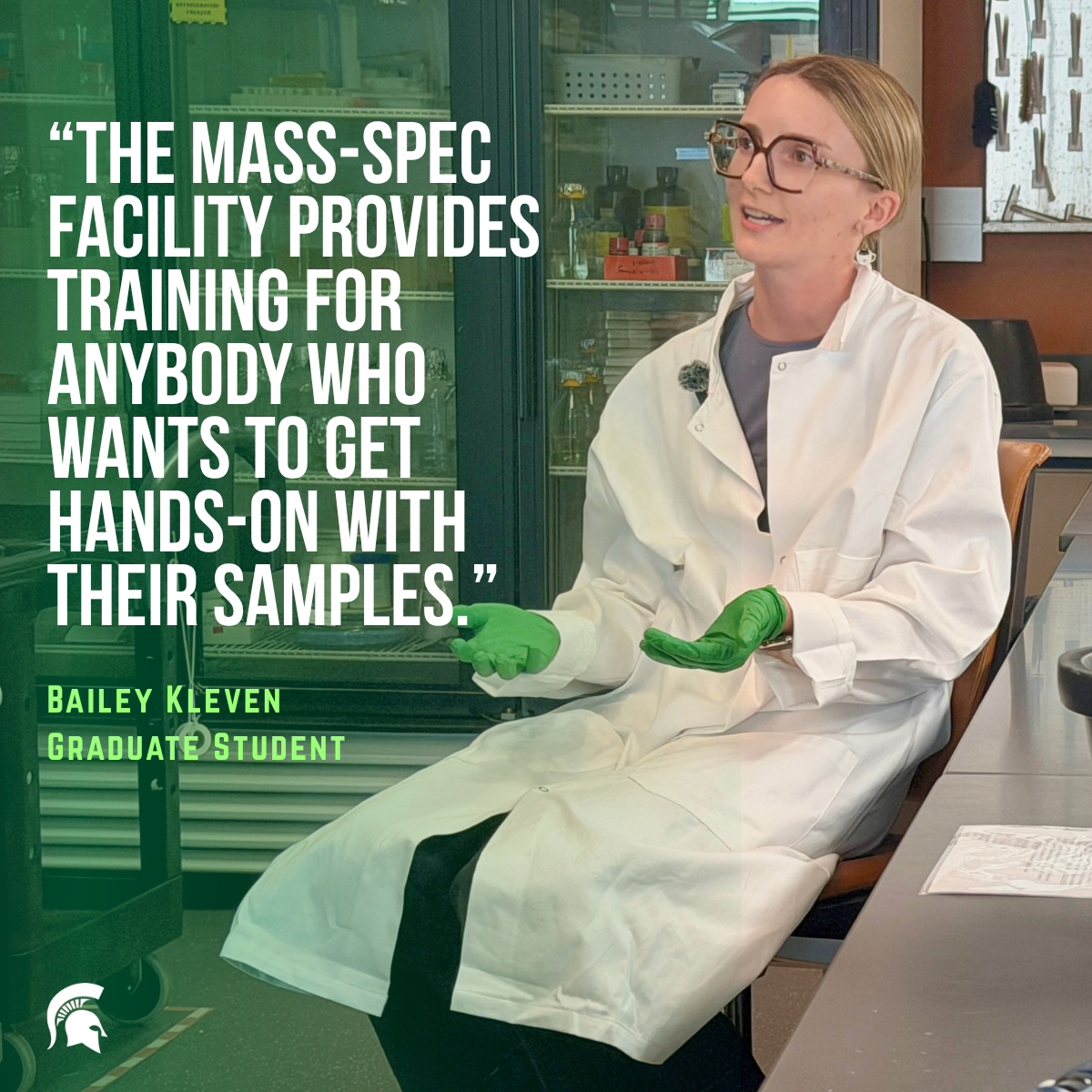
Graduate students like Kleven can receive hands-on training from the expert staff at MSU's Mass Spec Facility.
Image Credit: Connor Yeck/Caleb Hess, MSU
Connor Yeck/Caleb Hess, MSULC-MS offers a powerful tool for understanding how mutants produce different compounds
with altered compositions or at a modified ratio. But measuring these differences
is challenging. Samples must be carefully mixed, treated and analyzed using precision
instruments.
These molecules are separated via liquid chromatography and then charged and measured
by using mass spectrometry.
These ions, or charged particles, are then suspended in a vacuum before being pulled
toward a magnet. The lighter the mass of the ion, the more quickly it moves, while
heavier compounds gain momentum more slowly.
Kleven compares the process to hillclimb racing, where more lightweight competitors
can accelerate faster and get an edge on their heavier counterparts.
When these samples are analyzed in the Mass Spec facility, Kleven explains, the hard
work of preparing and separating them pays off: once they've been pulled apart, and
the component compounds can be identified and measured.
The power of LC-MS comes from how it allows researchers to get a better picture of
commingled compounds that are indistinguishable to the naked eye and challenging to
tease apart in other ways.
Beyond the research insights that the Mass Spec Core can offer, the staff facilitates hands-on training for anybody who wants to better understand how to use the facilities' tools in their own work. "The Mass-Spec facility provides training for anybody who wants to get hands-on with their samples," Kleven said.
"Campus core facilities are the pit crews of research — bringing specialized equipment, expert hands, and plenty of problem-solving to every project,” explains Goudarzi.
Watch the video below to see how Kleven uses the Mass Spec in her research: